



Anchor text over-optimization is a condition where keyword-rich anchor text is used excessively within a link profile. It is not about including keywords in anchor text. It is about imbalance.
Over-optimization occurs when a single keyword or phrase is disproportionately repeated across backlinks.
Understanding Anchor Text in Context
Anchor text is the clickable portion of a hyperlink.
Its function is to help search systems understand the relationship between the linking page and the linked page.
In a natural environment, anchor text varies.
Different authors write about the same topic in different ways. Some use brand names. Some use descriptive phrases. Others rely on partial matches or generic wording.
Variation reflects independent authorship.
Over-optimization begins where variation disappears.
What Makes Optimization Excessive
Optimization becomes excessive when patterns suggest coordination rather than organic reference.
A high concentration of identical commercial phrases is one indicator.

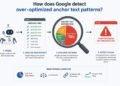
Search systems are designed to detect statistical imbalance. When anchor distribution becomes condensed around one specific term, the pattern shifts from natural to engineered.
The issue is not optimization itself. The issue is disproportion.
Why Search Systems React to It
Search engines rely on link signals to interpret relevance.
If anchor text were not evaluated for excess, it would be simple to manipulate rankings by repeating targeted phrases.
Over-optimization reflects artificial reinforcement. Instead of strengthening signals through contextual citation, it attempts to amplify them through repetition.
The probability of receiving numerous backlinks with identical anchor text from independent sources is low. When probability declines, interpretive confidence declines with it.
Search systems operate on statistical modeling. Improbable patterns reduce trust.
Natural vs. Engineered Distribution
In a balanced profile, anchor distribution includes brand mentions, descriptive phrases, partial matches, and generic terms.
In an over-optimized profile, distribution narrows. Variation decreases, and a dominant phrase absorbs disproportionate weight.
This shift from diversity to concentration is what defines the condition.
Why It Is a Spectrum Instead of a Switch
Anchor text over-optimization is not binary.
There is no universal percentage at which optimization becomes excessive. Competitive environments may naturally include some exact-match anchors.
The distinction lies in accumulation. When exact-match usage dominates beyond what probability would normally suggest, imbalance emerges.
Over-optimization is measured in relation to context, not in isolation.
Conceptual Perspective
Anchor text over-optimization is ultimately a matter of balance within a link profile.
Search systems evaluate patterns probabilistically rather than absolutely, which is how over-optimized anchor text is identified. When anchor usage appears unlikely to occur naturally, it signals artificial influence.
Understanding this reframes the concept from fear to structural awareness.
Language varies. Independent citation varies.
When variation collapses into repetition, systems notice.