
Sunday, March 15, 2026
BacklinkSense
  • Anchor Text
    • Anchor Text Context
    • Anchor Text Distribution
    • Anchor Text Strategy
    • Types of Anchor Text
  • Backlink Quality and Analysis
    • Authority and Trust Signals
    • Backlink Analysis Tools
    • Link Context
    • Link Placement
    • Link Quality Signals
    • Link Relevance
  • Link Building Basics
    • How Google Ranks Links
    • Types of Backlinks
    • What Are Backlinks
    • Why Backlinks Matter
  • Link Building Methods
    • Asset-Based Link Building
    • Content-Based Link Building
    • Digital PR and Authority Mentions
    • Passive Link Acquisition
    • Resource and Reference Links
  • Link Building Risks
    • Link Penalties
    • Link Velocity
    • Low-Quality Backlinks
    • Over-Optimized Anchor Text
    • Unnatural Link Patterns
  • Link Outreach
    • Finding Outreach Targets
    • Follow Up in Outreach
    • Outreach Email Strategies
    • Outreach Personalization
    • Relationship Based Outreach
No Result
View All Result
  • Anchor Text
    • Anchor Text Context
    • Anchor Text Distribution
    • Anchor Text Strategy
    • Types of Anchor Text
  • Backlink Quality and Analysis
    • Authority and Trust Signals
    • Backlink Analysis Tools
    • Link Context
    • Link Placement
    • Link Quality Signals
    • Link Relevance
  • Link Building Basics
    • How Google Ranks Links
    • Types of Backlinks
    • What Are Backlinks
    • Why Backlinks Matter
  • Link Building Methods
    • Asset-Based Link Building
    • Content-Based Link Building
    • Digital PR and Authority Mentions
    • Passive Link Acquisition
    • Resource and Reference Links
  • Link Building Risks
    • Link Penalties
    • Link Velocity
    • Low-Quality Backlinks
    • Over-Optimized Anchor Text
    • Unnatural Link Patterns
  • Link Outreach
    • Finding Outreach Targets
    • Follow Up in Outreach
    • Outreach Email Strategies
    • Outreach Personalization
    • Relationship Based Outreach
No Result
View All Result
BacklinkSense
No Result
View All Result
ADVERTISEMENT

Sustainable Link Prospecting Models in 2026: A Strategic Evaluation

Backlink Sense by Backlink Sense
February 25, 2026
in Finding Outreach Targets
Reading Time: 5 mins read
0
Share on FacebookShare on Twitter

Page Contents

  • 1 Why Prospecting Models Decline in Value Over Time
  • 2 Related Posts
  • 3 Common Link Prospecting Mistakes to Avoid: Execution-Level Errors
  • 4 Prospect Scoring Framework for Link Building Campaigns: A Computation Model
  • 5 How to Qualify Outreach Prospects – Relevance vs Authority
  • 6 How to Analyze Competitor Backlinks for Outreach Prospects: A Technical Workflow
  • 7 Footprint Decay as a Structural Problem
  • 8 Automation Risk and Structural Compression
  • 9 Manual Versus Scalable Systems
  • 10 What Makes a Prospecting Model Durable
  • 11 Where This Often Goes Wrong
  • 12 Looking Forward

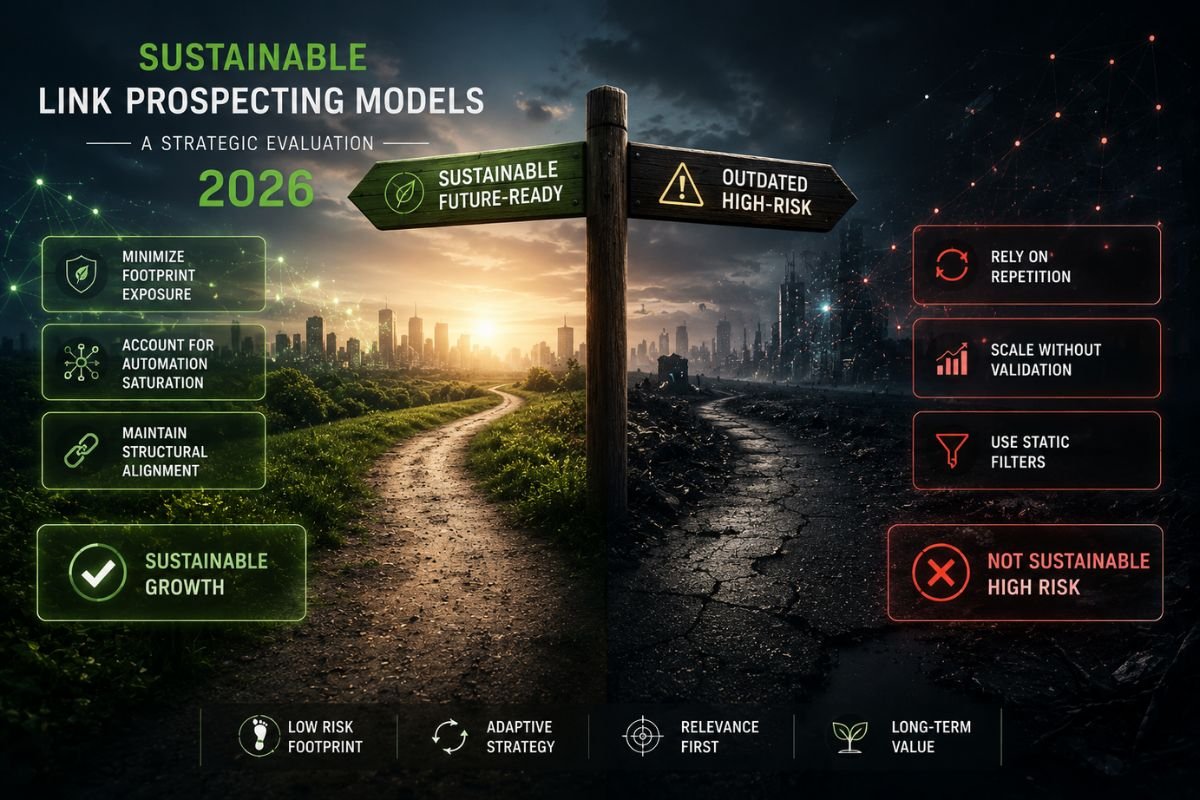
Sustainable link prospecting models in 2026 are those that minimize footprint exposure, account for automation saturation, and maintain structural alignment. Conversely, models that rely on repetition, scale without validation, or utilize static filters are not sustainable.

Most link prospecting models are effective in the short term. The decline occurs over time.

This article will not cover link prospecting strategies. Instead, it will examine which prospecting models remain sustainable over time and why.

Why Prospecting Models Decline in Value Over Time

Each time a prospecting model is applied, a footprint is created.

When a particular model becomes widely adopted, it becomes increasingly difficult to avoid leaving a footprint. Footprints are created through structural signals. Patterns emerge. Vocabulary becomes standardized. Target audiences converge. What was once considered organic becomes increasingly templated.

It is not search engines that see a footprint. It is the structural signals that are created.

Link prospecting models decline in value over time for three primary reasons:

  • Overexposure of identical filtering logic

  • Shared target audiences across models

  • Uniformity in selection behavior due to automation
    Related Posts

    Common Link Prospecting Mistakes to Avoid: Execution-Level Errors

    February 28, 2026

    Prospect Scoring Framework for Link Building Campaigns: A Computation Model

    February 28, 2026

    How to Qualify Outreach Prospects – Relevance vs Authority

    February 28, 2026

    How to Analyze Competitor Backlinks for Outreach Prospects: A Technical Workflow

    February 28, 2026

It is not the footprint itself that creates the issue. It is predictability.

A link prospecting model becomes unsustainable when it becomes predictable. This occurs when a model’s decision-making logic can be easily replicated.

Footprint Decay as a Structural Problem

Footprint decay is the gradual loss of uniqueness within a link prospecting model.

When a model is first applied, it carries a distinct footprint because it has not yet been widely used.

Over time, however, that uniqueness diminishes. Hundreds of similar models begin utilizing comparable search terms, filtering criteria, or automation scripts.

Sustainable prospecting models in 2026 must account for this decay.

The question is not whether a model currently works. The question is whether it will maintain a distinct signal profile once replicated by others.

Models built on mechanical filters tend to decay faster than those built on contextual filters.

Automation Risk and Structural Compression

Link prospecting has been significantly affected by automation. Automation has expanded surface area and reduced time per model. It is efficient.

The risk emerges in structural compression.

Different teams using different automated models can arrive at similar outputs. The risk is not the model itself. The risk lies in assuming uniqueness while operating within automated systems.

Automated prospecting models tend to:

  • Have limited filtering frameworks

  • Over-rely on quantifiable factors

  • Neglect contextual evaluation

  • Scale rapidly with minimal validation

The faster they scale, the less unique they tend to become.

In 2026, sustainable prospecting models must automate process support, not replace human judgment.

Manual Versus Scalable Systems

The manual vs. scalable debate in link prospecting is often misunderstood. Manual models are seen as safe but inefficient, while scalable models are viewed as efficient but risky. The truth is, it’s more complicated than that.

Manual models tend to be inconsistent. They rely heavily on human judgment. They are difficult to replicate and difficult to measure.

Scalable models tend to be consistent and efficient. They standardize behavior.

Sustainable prospecting models in 2026 combine both dimensions without defaulting to either extreme.

The sustainability threshold is met when:

  • The human element guides automation

  • Automation increases awareness but does not make final decisions

  • Prospect pools evolve rather than repeat

  • The system remains dynamic

What Makes a Prospecting Model Durable

Durability is not defined by output volume. It is defined by structural sustainability.

A durable model has several characteristics. It focuses on ecosystem mapping rather than hunting individual placements. It looks for clusters rather than isolated opportunities.

It separates discovery from validation. Discovery can scale. Validation requires human judgment.

It accounts for saturation. Any system that is easily replicated and documented will eventually saturate.

It adjusts its filters. Static qualification criteria produce static link graphs.

It considers exposure risk. Prospect pools degrade at different rates. Some degrade rapidly due to over-commercialization.

A durable system is built on adaptive logic rather than static efficiency.

Where This Often Goes Wrong

A common misconception is that sustainability equals moderation. It does not. Reducing output does not necessarily reduce footprint. Repetition, even reduced repetition, remains repetition.

Another misconception is that advanced tools guarantee stability. They do not.

The deeper issue is the assumption that scalability equals maturity. Many prospecting models scale successfully in early phases. Structural weaknesses only become visible through cumulative analysis.

Sustainable link prospecting models in 2026 are defined not by how efficiently they locate prospects, but by how effectively they avoid systemic pattern exposure.

The distinction is subtle but fundamental.

Looking Forward

Prospecting is no longer about discovery. It is about differentiation.

As automation becomes standard and datasets merge, competitive advantage shifts from novelty to interpretive filtering.

Models that rely solely on novelty fail. Models that rely solely on structure compress. Models that evolve internal logic while maintaining contextual discipline are more likely to endure.

Within the broader framework of Finding Outreach Targets, sustainability is the core concept.

Not speed.
Not scale.
Not access.

Sustainable link prospecting models in 2026 are designed with decay in mind. They assume exposure. They assume replication. They assume saturation.

And they evolve before those forces become visible.

Tags: Link ProspectingSearch Ecosystem DynamicsSustainable SEO Systems
ShareTweetPin

Related Posts

Finding Outreach Targets

Common Link Prospecting Mistakes to Avoid: Execution-Level Errors

by Backlink Sense
February 28, 2026
0

Most prospecting errors are subtle. They rarely feel catastrophic. They often appear efficient. Over...

Read moreDetails

How to Find Guest Post Opportunities in Any Niche: A Tactical Discovery Guide

February 28, 2026

Using Google Search Operators to Find Outreach Targets: Technical Execution Guide

February 28, 2026

Link Prospecting Methods That Actually Work in 2026: Tactical Field Manual

February 28, 2026

Leave a Reply Cancel reply

Your email address will not be published. Required fields are marked *

  • About Us
  • Terms of Use
  • Use of Cookies
  • Affiliate Disclosure
  • Contact
  • Privacy Policy
2026 BacklinkSense © All rights reserved.

Welcome Back!

Login to your account below

Forgotten Password?

Retrieve your password

Please enter your username or email address to reset your password.

Log In

Accessibility Toolbar

  • Powered with favoriteLove by Codenroll
No Result
View All Result
  • Anchor Text
    • Anchor Text Context
    • Anchor Text Distribution
    • Anchor Text Strategy
    • Types of Anchor Text
  • Backlink Quality and Analysis
    • Authority and Trust Signals
    • Backlink Analysis Tools
    • Link Context
    • Link Placement
    • Link Quality Signals
    • Link Relevance
  • Link Building Basics
    • How Google Ranks Links
    • Types of Backlinks
    • What Are Backlinks
    • Why Backlinks Matter
  • Link Building Methods
    • Asset-Based Link Building
    • Content-Based Link Building
    • Digital PR and Authority Mentions
    • Passive Link Acquisition
    • Resource and Reference Links
  • Link Building Risks
    • Link Penalties
    • Link Velocity
    • Low-Quality Backlinks
    • Over-Optimized Anchor Text
    • Unnatural Link Patterns
  • Link Outreach
    • Finding Outreach Targets
    • Follow Up in Outreach
    • Outreach Email Strategies
    • Outreach Personalization
    • Relationship Based Outreach

2026 BacklinkSense © All rights reserved.

This website uses cookies to improve your experience and analyze site performance. By continuing to browse, you agree to our Privacy and Cookie Policy.