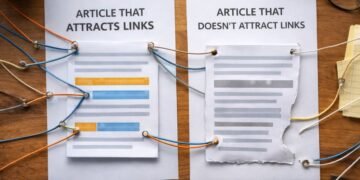


A writer is working on an article about getting better sleep and reaches a claim about how much sleep adults generally need.
Rather than simply asking readers to trust the claim, the writer finds a useful medical source that explains the recommendation and links to it.
Nobody told the writer to include that particular website. The website did not pay for the mention, provide the article, or require a link in return for something else. The writer simply decided that the source would make the article more useful.
That is the basic idea behind an editorial backlink.
A backlink is a link from one website to another. When the person creating the content independently decides that another page deserves to be linked because it helps the content, that link can be described as editorial.
What makes it different is therefore not how the backlink looks, but how the backlink was obtained.
What Makes the Backlink Editorial?
Go back to our article about sleep. The writer might need a source for a statistic, a medical explanation that would take too long to reproduce, or a study readers may want to examine for themselves, so the search for a useful source becomes part of creating the article.
Perhaps several sources are available. The writer reads them, decides which one is useful for the point being made, and includes a link.
The important part happens at that decision. The source was not included because a contract required it or because another website supplied a link that had to appear. The person responsible for the article chose the source while deciding what would make the content more useful.
That independent choice is what separates editorial backlinks from many other types of backlinks.
Why Do Writers Create Editorial Backlinks?
Not every article can contain everything a reader might want to know, which gives writers plenty of practical reasons to send readers somewhere else.
A journalist discussing a scientific finding may link to the original study. A technology writer reviewing a new feature may link to the company’s documentation. Someone explaining a complicated subject may link to a detailed guide that answers a question outside the scope of the article.
In each case, the link gives the reader somewhere useful to go next.
This also explains why citations can produce editorial backlinks naturally. A writer may want to show where a statistic came from, identify the original source of information, or give readers access to evidence behind a claim.
The writer may not be thinking about backlinks at all. From their perspective, they are simply citing a useful source. From the perspective of the website receiving the link, however, a backlink has been created.
Can You Recognize an Editorial Backlink Just by Looking at It?
Imagine seeing the words adult sleep recommendations linked in the middle of an article. Nothing about those clickable words tells you whether the writer independently found the source, received it from someone else, or included it as part of another arrangement.
That is why appearance alone cannot tell you the entire story behind how a link got there.
The word editorial describes the decision behind the link, not a particular visual format. An editorial backlink could appear in a news report, research article, guide, educational resource, commentary, or another type of content. There is no special color, position, or anchor text that automatically turns a backlink into an editorial one.
Does an Editorial Backlink Have to Cite Research?
Research makes the idea particularly easy to see, but editorial backlinks are certainly not limited to studies and statistics.
Suppose someone is writing a guide to visiting Rome and mentions a museum with unusual opening hours. Linking to the museum’s official visitor information could help readers check those hours themselves.
Or imagine a writer explaining how a complicated piece of software works. Instead of turning one paragraph into a lengthy technical explanation, the writer might link to documentation that covers that particular feature in detail.
Neither example involves a research study, yet the same principle is at work: the writer found another page useful to the content and chose to reference it.
This is why editorial backlinks can take many forms. The broader Types of Backlinks collection places editorial links alongside the other ways backlinks can appear across the web.
Does Editorial Automatically Mean High Quality?
Calling a backlink editorial does not automatically make it high quality. The term tells us something about why the link was included, but it does not tell us everything about the quality of the website, the relevance of the page, or the usefulness of the link.
A writer can independently choose a poor source. A link can be editorially selected but still appear on a page that has little connection with the destination. The label does not make every other question about backlink quality disappear.
There is another reason to keep the distinction clear. Google warns about links created primarily to manipulate search rankings, including certain paid links and link arrangements. That is different from saying that anything described as editorial automatically receives special ranking value.
So editorial backlink should not be treated as another way of saying “a backlink Google will definitely value highly.” It describes how the linking decision happened.
Why Are Editorial Backlinks Discussed So Often in SEO?
The interest becomes easier to understand when we return to the writer from the beginning of the article.
They had something to explain, needed a useful source, found one, and decided that giving readers access to it would improve the article. The website receiving the backlink did not need to be the subject of the story. Its page simply had information worth referencing.
That is what makes the concept useful in SEO discussions. Instead of beginning with the goal of creating a backlink and then looking for somewhere to place it, the link can emerge from the ordinary process of creating useful content and choosing useful sources.
In our sleep example, the backlink was not the reason the article existed. It appeared because the source had a reason to be there.